“Because if I tell you too early, you change things too far. The moment never happens. My son dies.”
My throat tightens. “And if the moment never happens for me?”
The words land between us like glass.
“I do not want to play with fate,” I whisper.
“You already do,” she says gently. “So do I.”
She stands. “Tomorrow night. Rain. Highway 214. You take that road instead of the side streets. You stop when you hear the crash.”
My stomach twists. Every instinct screams to run from this woman, to take my child and flee somewhere no future can find me. But the memory of that trapped boy’s scream echoes in my bones. The certainty in her eyes binds me tighter than fear.
“What happens after?” I ask.
She smiles softly. “After, I wait my turn to return what you give me.”
The next night, rain lashes the windshield as I drive. My son sleeps in his car seat, small chest rising and falling, unaware that the world balances on a narrow edge. My hands sweat around the steering wheel. Every mile makes my heart pound louder.
The screech of tires. The sickening impact. The explosion of glass.
Time shrinks.
I slam the brakes, leap from the car, shielding my son with one last glance before sprinting toward the wreck. The scene unfolds exactly as the dream shows it. The smoke. The trapped vehicle. The terrified child in the backseat, screaming for his mother.
I do not freeze.
I run.
Rain mixes with blood as I wrench open the door. Another figure joins me—her. Blood on her face. Same woman, but now younger, frantic, desperate. The moment bends around us like it has waited for this shape.
We pull the boy free together just as the flames erupt.
Later, in the hospital hallway, she grabs my shaking hands. “You saved him,” she sobs. “I will never forget you.”
I see now—this is the moment where the loop seals itself.
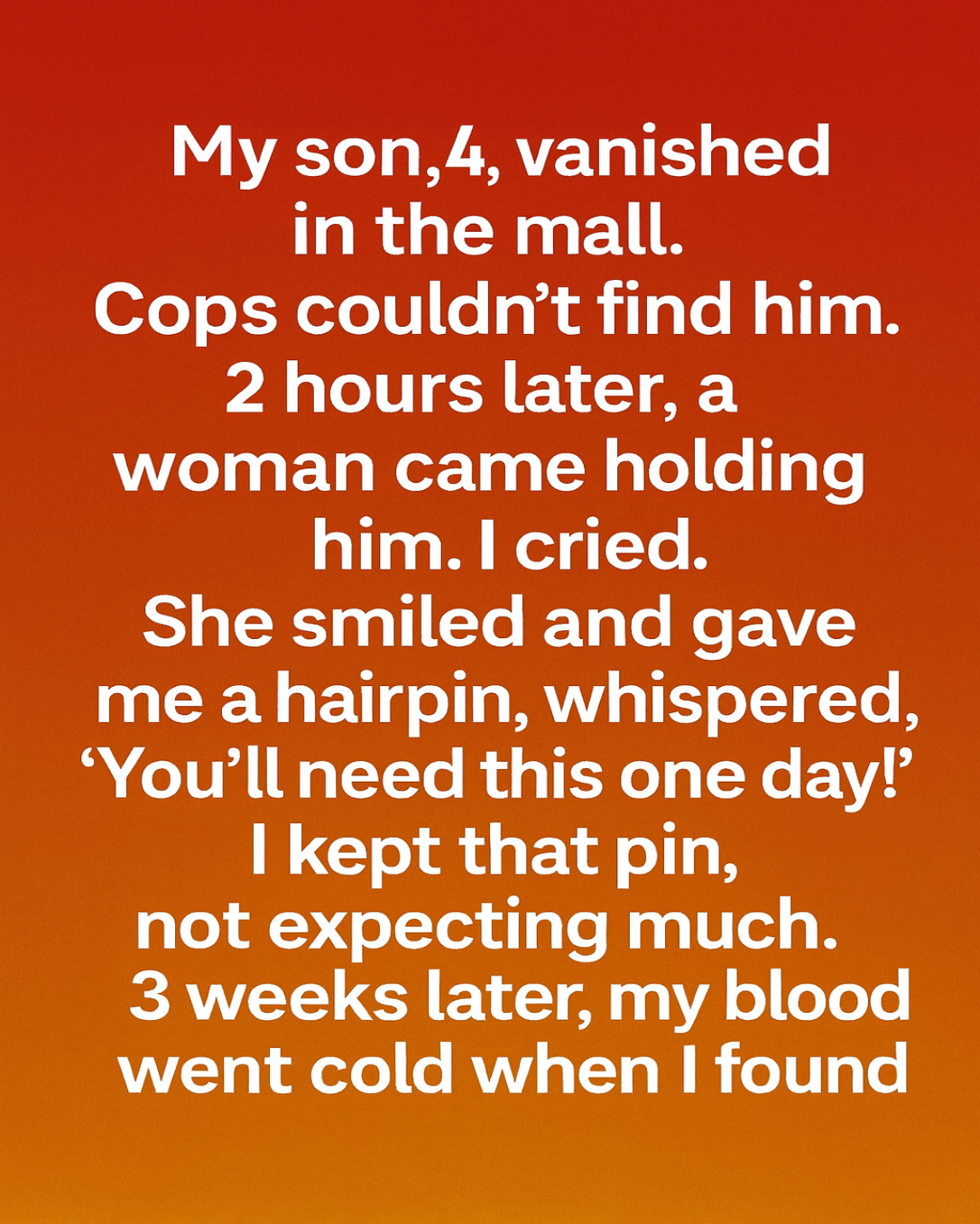
Days later, at the mall, she will find me again, frightened and unaware, and return what I have already given her.
Weeks later, she will place the pin where I must see it.
Now the circle is complete.
Weeks pass. The fear loosens its grip. My son laughs easily again. The world feels steady in a way it never has before—not because it is safe, but because it is understood.
One afternoon at the playground, the woman appears one final time. She does not stand apart now. She sits beside me like a normal mother.
“Our debts are even,” she says.
“Not debts,” I answer. “Lives.”
She nods. “I will never touch your child again.”
“And I will always stop when I hear a crash,” I say.
We share a quiet smile.
Then she rises. Walks away. This time, I watch her fade into the crowd like any ordinary person, and for the first time, she does not vanish unnaturally.
That night, I remove the hairpin from my dresser. I place it in a small wooden box with other things that matter—hospital bracelets, baby shoes, photographs of moments that almost slip away.
I understand now that time is not a straight line.
It is a promise we keep, again and again, without always knowing how.
And every night, as my son sleeps safely in the next room, I do the one thing that will always matter most.
I listen.
