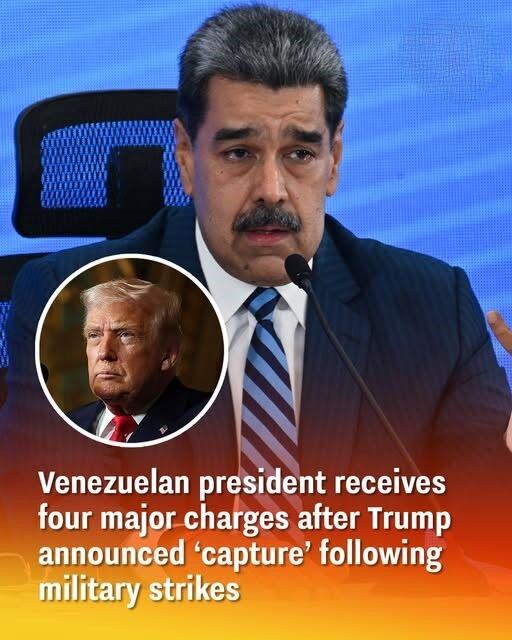
Cocaine importation conspiracy
Conspiracy to possess such weapons against the United States
Bondi characterized Maduro as a key figure in international narcotics trafficking and vowed that he would “face the full wrath of American justice” in U.S. courts.
She also acknowledged the complexity of the operation and praised U.S. military and law enforcement coordination.
As of the latest official information, specific details on the charges against Cilia Flores have not yet been fully disclosed, though she was included in the indictment — meaning prosecutors are pursuing legal action against both individuals.
Historical Context of the Indictments
Maduro had previously been indicted by U.S. authorities in 2020 on drug trafficking and related criminal charges.
Those earlier charges alleged Maduro and members of his circle participated in international drug trafficking networks that brought cocaine into the United States and supported terrorism and violent crime in the Western Hemisphere.
Despite the existing indictments, Maduro remained in power through years of political conflict, disputed elections, and international sanctions — until the January 3 operation effectively brought him into U.S. custody.
Prosecutors now plan to proceed with a renewed case under U.S. criminal law.
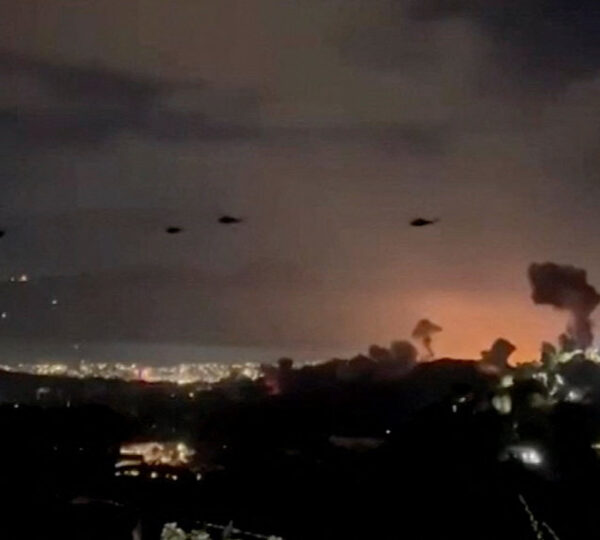
The U.S. military action and reported capture of a sitting head of state have drawn intense and polarized reactions worldwide, with states and international organizations expressing support, condemnation, or calls for restraint.
Latin America and Neighboring States
Venezuela’s government strongly denounced the strikes as a violation of sovereignty, with Vice President Delcy Rodríguez declaring Maduro the legitimate president and demanding proof that he and Flores were alive.
Rodríguez also asserted her constitutional role under Venezuelan law, though her status remains contested amid communication breakdowns.
Venezuelan Defense Minister Vladimir Padrino López labeled the attack “criminal military aggression” and urged national defense and mobilization of Venezuelan forces.
Global Responses
Reactions from outside the region were deeply divided:
Russia, Iran, Cuba, and other allied states condemned the U.S. operation as a breach of international law and a violation of Venezuela’s territorial integrity.
Many Latin American governments and regional leaders criticized the strikes as an infringement on sovereignty and warned that such actions could destabilize the region.
Colombia’s president described the operation as an assault on regional sovereignty, while others called for adherence to international legal norms.
European Union leaders and the United Nations called for restraint and emphasized that any transition in Venezuela must respect international law and the U.N. Charter. A UN Security Council meeting was scheduled to discuss the crisis.
Some nations opposed to Maduro’s government nonetheless expressed concern that a foreign military assault could worsen humanitarian conditions or provoke further escalation.
Legal and Diplomatic Implications
The U.S. military action represents a significant legal and diplomatic escalation — both for U.S.–Venezuela relations and for broader international norms concerning sovereignty and the use of force.
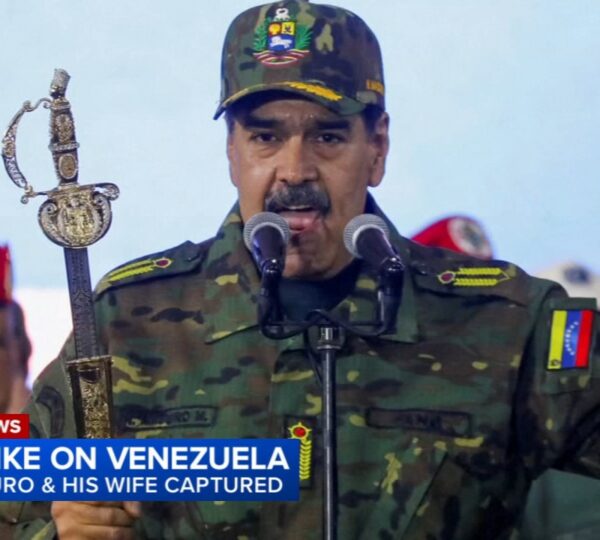
Under international law, the use of military force against a sovereign state without explicit authorization from the United Nations Security Council or the host government challenges widely accepted legal frameworks, including the U.N. Charter.
Legal scholars and diplomats have already raised questions about whether the operation is compatible with those standards, especially given that narcotics trafficking charges alone do not typically provide a statutory basis for unilateral military intervention.
Within the United States, lawmakers and constitutional experts are debating whether adequate congressional authorization was obtained for the military action.
The U.S. Constitution assigns to Congress the power to authorize war and extended use of force, and some analysts have suggested that this requirement should apply to the Venezuelan operation.
Human and Structural Impact in Venezuela
Independent verification of on‑the‑ground casualties and infrastructure damage remains limited. Early reports suggest that U.S. strikes caused significant destruction to military installations in Caracas, contributing to disruptions in power and public services.
Satellite imagery analyzed by defense analysts shows substantial damage to parts of the Fuerte Tiuna complex, though civilian casualty numbers are not yet independently confirmed.
The Venezuelan government declared a state of external disturbance in response to the strikes, and there are indications that national defense plans were activated.
The situation in major cities like Caracas remains tense, with reports of explosions and significant military presence.
Amid the crisis, Venezuelan citizens have faced heightened uncertainty, including mixed messages from authorities and concerns about safety.
The U.S. Embassy has issued advisories for American citizens in Venezuela to shelter in place or depart when possible.
Current Status and What Comes Next
Legal Proceedings
Maduro and Flores are reported to be in U.S. custody and in New York, where the federal indictment awaits them in the Southern District of New York.
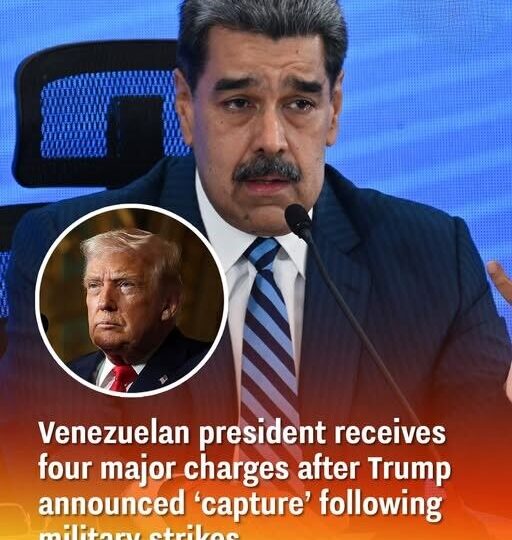
Prosecutors are preparing to move forward with trial proceedings under U.S. law.
Venezuelan Governance
Inside Venezuela, the leadership situation remains contested. While Rodríguez has claimed presidential authority under the constitution, her claim is disputed by many Venezuelans and international observers who view the U.S. operation as invalid without due process.
International Diplomacy
The United Nations Security Council is poised to address the matter formally, with several members urging de‑escalation and adherence to international law.
Diplomatic pressure continues to build on both sides. Continue reading…
