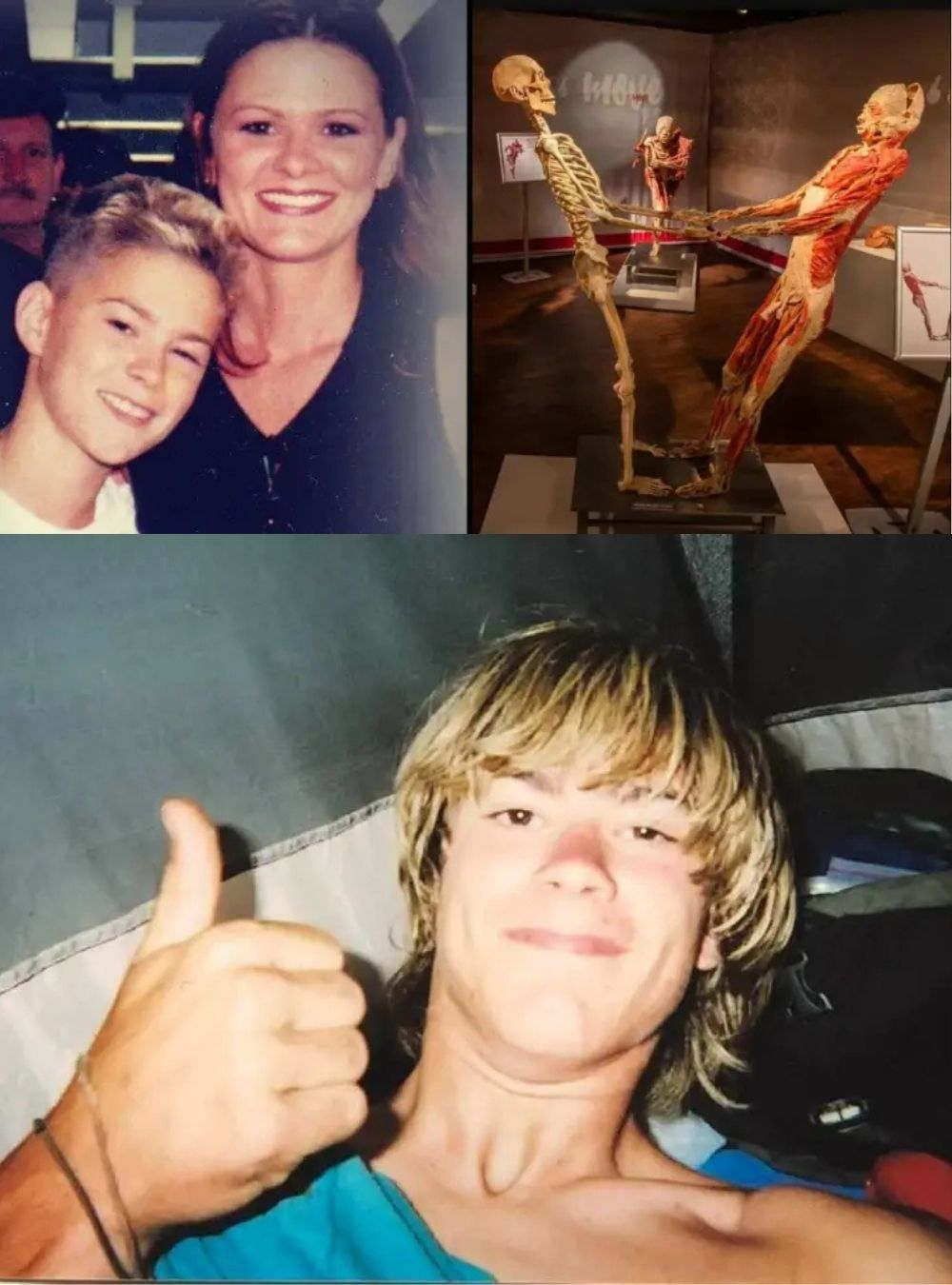
A grieving mother has shared a deeply unsettling theory after claiming she came face to face with what she believes was her son’s preserved body during a visit to a controversial museum exhibition.
Kim Erick says her life was turned upside down after visiting the Real Bodies exhibition in Las Vegas, where plastinated human cadavers are displayed for educational purposes. Among the specimens, one figure left her frozen in shock. Kim became convinced she was looking at the remains of her son, Chris Todd Erick, who died under mysterious circumstances in 2012 at the age of 23.
A death surrounded by unanswered questions
Chris Todd Erick was found dead in November 2012 at his grandmother’s home in Midlothian, Texas. At the time, authorities told the family he had died peacefully in his sleep after suffering two heart attacks related to a congenital heart defect.
Chris’s father handled the cremation, and Kim says she was given only a small necklace said to contain some of her son’s ashes. No funeral service was held. From the beginning, Kim says something felt wrong.
Driven by unease, she later requested police records and crime scene photographs. What she saw, she claims, was disturbing: visible bruising, cuts, and what she believes appeared to be dry cyanide residue near her son’s mouth. One image showed a chair with straps, which Kim says appeared consistent with marks visible on Chris’s body.
A reexamination of a preserved blood sample later revealed lethal levels of cyanide. Chris’s cause of death was officially changed to cyanide toxicity and ultimately ruled a suicide of undetermined means. A grand jury reviewed the case in 2014 but found no evidence of criminal wrongdoing.
Kim has never accepted that conclusion.
“I knew my son,” she has said. “Nothing about this made sense.”
The museum encounter that reopened old wounds
Years later, Kim encountered coverage of the Real Bodies exhibition, which features more than 20 preserved human cadavers. One specimen—often referred to as The Thinker—immediately caught her attention.
She says the resemblance was overwhelming. Kim claims she recognized specific facial features and a skull fracture similar to one documented in Chris’s autopsy records. What troubled her most, however, was what appeared to be missing skin from the shoulder area.
“Tattoos usually remain visible on plastinated bodies,” Kim explained. “The only way it wouldn’t be there is if the skin had been removed.”
She contacted the exhibition repeatedly, urging administrators to perform DNA testing. According to Kim, the specimen later vanished from the Las Vegas exhibit, with unconfirmed reports suggesting it may have been moved elsewhere.
The museum’s firm denial
Imagine Exhibitions, the company behind Real Bodies, has strongly rejected Kim’s allegations. The company states that the specimen in question has been on display since 2004—years before Chris’s death—and insists all bodies are ethically sourced and biologically unidentifiable.
“There is no factual basis for these claims,” the company said, expressing sympathy while maintaining that the timeline alone makes the theory impossible.
A chilling new possibility
Kim remains unconvinced. She is now investigating whether her son’s remains could be connected to hundreds of unidentified cremated remains discovered earlier this year in the Nevada desert. The origins of those ashes have not yet been confirmed.
“I just want them tested,” she said. “If there’s even a chance my son is there, I need to know.”
More than 13 years after Chris’s death, Kim’s search for answers continues—not driven by accusation, she says, but by a need for truth.
