In a major religious liberty ruling with far‑reaching implications for American workplaces.
The U.S. Supreme Court has handed down a unanimous decision in favor of a Pennsylvania postal worker, clarifying how employers must handle religious accommodation requests under federal law.
The case, known as Groff v. DeJoy, centers on whether employers can require employees to work on days that conflict with their deeply held religious beliefs — and how far companies must go to accommodate such requests under the Civil Rights Act of 1964.
The Court’s decision — handed down on June 29, 2023 — was unanimous (9‑0), signaling strong agreement among justices from across the ideological spectrum on the importance of religious liberty in the workplace.
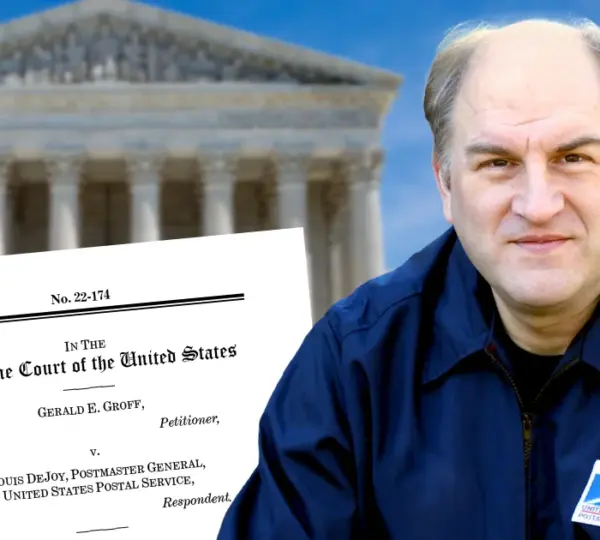
What had been a narrow dispute involving a rural mail carrier from Pennsylvania has now become one of the most important Supreme Court decisions in decades on the meaning and scope of workplace religious accommodation.
The Central Question: Sunday Deliveries vs. Sabbath Observance
At issue in the case was Gerald E. Groff, a former United States Postal Service (USPS) employee from Lancaster County, Pennsylvania.
Groff is a devout Evangelical Christian who observes the Sabbath on Sunday — a day of worship and rest in his faith tradition.
For years, Groff’s job as a Rural Carrier Associate allowed him to avoid Sunday work without significant conflict, and the Postal Service made efforts to accommodate his religious practices.
However, the situation changed after the USPS entered a contract with Amazon.com in 2013 that included Sunday package deliveries as part of the agency’s strategy to remain financially viable.
As Sunday deliveries became routine, Groff found himself scheduled for Sunday shifts that conflicted with his religious observance.
Groff offered to take additional weekday or holiday work to make up for any shift he would miss because of his Sabbath, but the Postal Service ultimately disciplined him for repeatedly missing Sundays when no substitute carrier could be found.
After a period of disciplinary action, Groff resigned from his position in 2019 and filed a lawsuit, arguing that the Postal Service had violated Title VII of the Civil Rights Act of 1964 by failing to reasonably accommodate his religious beliefs.

Title VII and the “Undue Hardship” Standard
Title VII broadly prohibits discrimination in employment based on religion — along with race, sex, and national origin — and requires employers to reasonably accommodate an employee’s religious practices unless doing so would result in an “undue hardship” on the business.
For nearly 50 years, courts interpreted the phrase “undue hardship” based on a 1977 Supreme Court case, Trans World Airlines, Inc. v. Hardison. In that decision, the Court held that employers need not grant accommodations that impose “more than a de minimis cost” on the employer.
Essentially, this meant that even relatively minimal burdens on the business could justify refusing a religious accommodation.
Over time, critics of the Hardison standard argued that it drastically weakened workers’ religious protections under Title VII, permitting employers to deny accommodations for even modest costs or inconveniences.
Many observers, including Groff’s legal team, said the “more than de minimis” test was inconsistent with the plain language of Title VII and failed to reflect how “undue hardship” is applied in other federal contexts.
Arguments Before the Court
Groff’s attorneys urged the Supreme Court to revisit the Hardison precedent and adopt a higher standard for evaluating undue hardship — one more consistent with the statutory language of Title VII and similar tests used in disability law (such as under the Americans with Disabilities Act).

They argued that employers should be required to show that granting a religious accommodation would result in “substantial increased costs” in the operation of the business before being permitted to deny it.
In support of that argument, many religious organizations and civil rights groups filed briefs with the Court.
They noted that under the Hardison standard, employers could too easily justify denying religious accommodations, particularly harming workers of religious minorities whose practices might not align with standard workplace scheduling.
Groups representing Muslim, Jewish, Hindu and other faith communities told the Supreme Court that the Hardison precedent forced employees to choose between their faith and their livelihood and that the standard should be clarified or overturned.
Postal worker unions, including the American Postal Workers Union, also weighed in prior to the decision, warning that special scheduling for religious accommodations could create tensions and burdens for coworkers — particularly in operations where a common day off helps with family time and community life. Continue reading…